EMI-TA Workshop
- Published on
- Author
- 張怡婷
EMI-TA Workshop
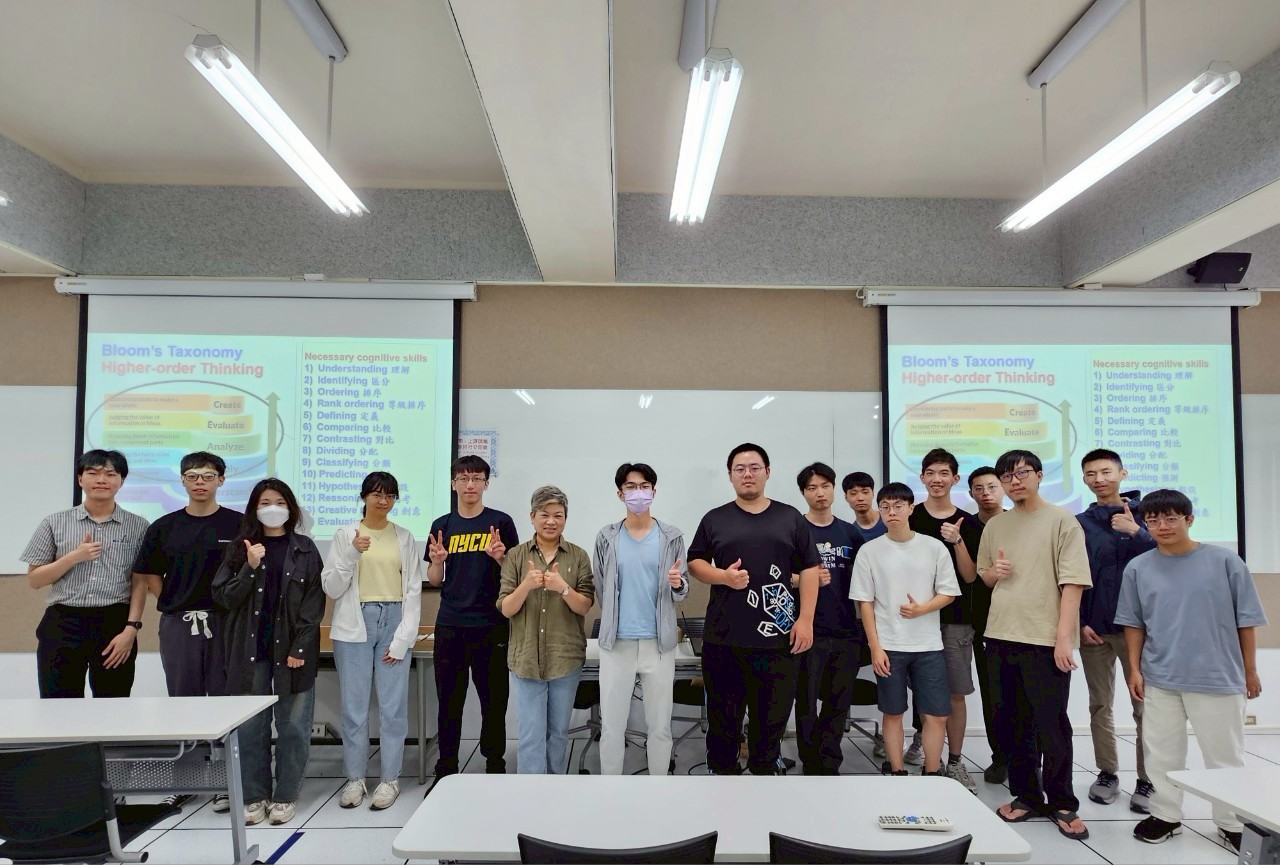
In response to the trend of internationalization in higher education and the enhancement of the practical competencies of EMI (English as a Medium of Instruction) teaching assistants in English-mediated classrooms, the Bilingual Education Task Force Team of the College of Computer Science, National Yang Ming Chiao Tung University, held the "EMI-TA Workshop" in the second semester of Academic Year 113. The workshop aimed to equip current and prospective EMI TAs with effective communication skills and self-confidence in the English-speaking teaching environment. The workshop was delivered by Wendy Hsueh, an EMI Specialist at the Higher Education Accreditation for Teaching (HEAT) at NYCU. The session centered on three focal areas: establishing a new EMI mindset, refining in-class support strategies, and cultivating higher-order thinking skills.
In terms of establishing a new EMI mindset, the lecturer emphasized the importance of shifting from traditional lecture-based teaching to a student-centered approach, and suggested that instructors should provide student with more opportunities to speak, thereby increasing Student Talking Time (STT). Instructors should apply diverse communication methods to encourage students to actively participate in learning, rather than just teachers passing on knowledge in one direction.
Refining in-class support strategies specifically explores the practical techniques of "Explaining Concepts" and "Guiding Class Discussions." In explaining concepts, the focus is on using "Plain English" to clarify professional concepts in each discipline through strategies, such as changing word forms, using synonyms and antonyms, and providing examples to concretize abstract concepts. As for guiding class discussions, participants were guided to learn how to change from the traditional "Initiation-Response-Feedback (IRF)" class model to a discussion design that encourages "peer communication" and "student-student-interaction." This approach cultivates key communicative skills, including expressing agreement or disagreement, clarifying unclear points, raising questions, describing cause and effect, sharing and explaining opinions, predicting outcomes, and proposing solutions.
Finally, the lecturer demonstrated how to apply "Bloom’s Taxonomy" to design questions that develop students’ higher-order thinking. Rather than designing questions that only focus on lower cognitive skills such as Remember and Understand, EMI classroom discussion questions should aim to stimulate students to engage in deeper cognitive skills such as Analyze, Apply, Evaluate, and Create.
According to the survey, this workshop successfully attracted a total of 15 participants. Results indicated an average satisfaction score of approximately 4.4 out of 5 regarding how this workshop helped participants better understand the responsibilities of EMI TAs. Participants also found this workshop to be highly beneficial to their future careers as EMI TAs, with an average satisfaction score of about 4.3 out of 5.
Participants also shared many valuable suggestions in their feedback. For example, they expressed interest in future sessions that focus on "improving English proficiency," "enhancing English speaking vocabulary," and having more opportunities to practice "using English for communication." Their feedback reflected a clear need to strengthen oral proficiency and communicative competence. In addition, some participants hoped to learn more strategies, such as "how to lead discussions" and "how to explain and guide students to express their opinions and ideas in large classes." Several also suggested that it would be beneficial to create opportunities for TAs from different EMI courses to exchange experiences and activity designs.
Overall, the "EMI-TA Workshop" provided valuable hands-on training for current and prospective EMI TAs at NYCU, and received highly positive recognition from the participants. In the future, the CS Bilingual Education Task Force Team will continue to refine workshop content and delivery based on the feedback in order to provide a higher-quality EMI-TA training environment and enable EMI TAs to be more internationally competitive.