Bridging Languages and Disciplines: Prof. Shuo-Han Chen on EMI Teaching Practices Under the US-Australian Dual Training Model
- Published on
- Author
- 林珮雯
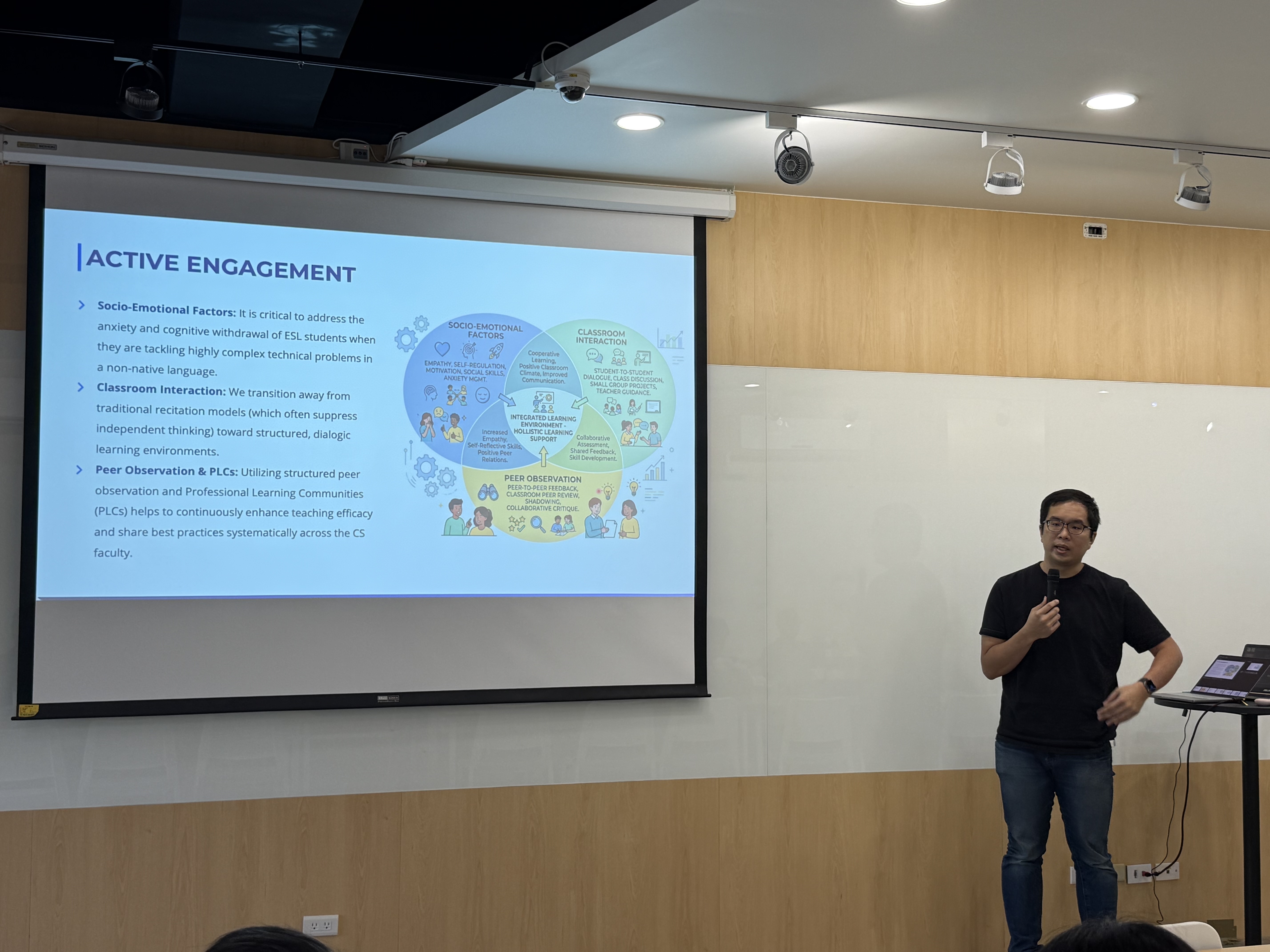
Amid the wave of internationalization, EMI (English as a Medium of Instruction) has become a major trend in university education. However, for professors in STEM fields, EMI is not simply a matter of switching the language of instruction from Chinese to English. Instead, it involves multi-faceted challenges including curriculum design, student learning psychology, classroom interaction, and assessment methods.
Associate Professor Shuo-Han Chen from the Department of Computer Science and Information Engineering shared his experience participating in the Ministry of Education's Bilingual Program. He traveled abroad for training programs at two world-renowned universities: UCSD (University of California, San Diego) and UNSW (University of New South Wales, Australia). From an international pedagogical perspective, combined with his own firsthand observations in computer science education, Prof. Chen explores the core philosophy of EMI teaching and its potential future directions.
The Core Challenge of Hard EMI: Avoiding Construct-Irrelevant Variance
Prof. Chen pointed out that the focus of EMI is not merely about lecturing in English, but rather ensuring that students truly comprehend professional, specialized knowledge. The training programs specifically clarified the distinction between "Hard EMI" and "Soft EMI." In humanities and social science disciplines (Soft EMI), language itself is often part of the learning content. However, computer science is a typical "Hard EMI" field—English is merely a vehicle for knowledge transfer, not the core of the course.
"We must separate a student's technical capability from their English fluency in both our grading mechanisms and curriculum design. What we should be assessing is programming logic, algorithm design, and system architecture, not whether their grammar is perfect or their accent is standard," Prof. Shuo-Han Chen emphasized.
If a student's professional academic capability is underestimated due to language limitations, it constitutes an unfairness in teaching. Therefore, in practice, instructors should use simple and accessible vocabulary when designing exam questions, and even allow students to clarify terminology in Chinese when necessary. This ensures that differences in language proficiency do not hinder students from demonstrating their professional capabilities.
Insights from US-Australian Dual Training: From Student Support to Instructional Design
Through his dual overseas training experiences, Prof. Chen deeply experienced the distinct differences in pedagogy between the US and Australia.
The United States focuses heavily on classroom interaction and student psychological states. Research shows that even with a certain level of language proficiency, students can still experience anxiety due to the cognitive load of learning complex specialized knowledge in a non-native language, which in turn reduces their willingness to participate. Therefore, American scholars pay close attention to the socio-emotional factors of ESL (English as a Second Language) students in all-English classrooms. They emphasize building a sense of connection between instructors and students, and encourage creating an inclusive, low-anxiety learning environment.
Conversely, Australia exhibits a strong "instructional engineering" character, placing greater emphasis on the systematic thinking of curriculum planning and instructional design. From setting course objectives and arranging teaching activities to constructing assessment mechanisms, Australia emphasizes using structured workflows for planning. This ensures that students' learning outcomes closely align with course goals and can be effectively measured.
In Prof. Shuo-Han Chen's view, although the training experiences in the US and Australia have different emphases, they both point to the same core question: how to maintain the depth of professional knowledge while increasing student engagement in EMI classrooms. These observations have prompted him to re-examine his own teaching methods and explore instructional strategies that better fit the needs of local students.
Breaking the Monopoly of Language Advantage: Giving Every Student a Chance to Participate
In group collaboration scenarios within computer science courses, students with stronger English expression skills often dominate the discussions. Meanwhile, those with weaker English skills tend to withdraw, becoming passive "followers" rather than active "creators."
To address this, the training programs placed special emphasis on improving the quality of participation through structured interaction design. For instance, establishing clear role-division mechanisms in group activities or using rotation systems ensures that all students have the opportunity to take on different tasks and responsibilities, preventing discussions from being monopolized by a few individuals.
Furthermore, students' methods for demonstrating learning outcomes should not be limited to oral expression. Prof. Chen shared that many computer science concepts can actually be presented through diverse formats such as flowcharts, concept maps, pseudo-code, or peer feedback. When instructors provide more flexible pathways for expression, students can focus their energy on knowledge comprehension and problem-solving, rather than worrying excessively about whether their spoken English is fluent enough.
New Teaching Roles in the AI Era: The Dual Transformation of Technology and Assessment
In pushing for instructional innovation, Prof. Shuo-Han Chen also actively embraces technology, viewing AI as an "Instructional Copilot." He noted that AI's value is not only felt on the student side but also serves as a crucial assistant for instructors. For example, it can assist in creating bilingual teaching materials, organizing technical terminology, designing code-debugging problems, and even generating practice content of varying difficulties, which significantly reduces the burden of lesson preparation.
Facing the impact of generative AI on higher education, Prof. Chen believes that instead of banning it entirely, it is better to establish clear and transparent guidelines for its use. Drawing from the practical experience of UNSW, he proposed establishing different "Levels of AI Assistance" based on course requirements—ranging from Level 1 (completely banned) to Level 5 (allowing full assistance for learning)—allowing technology to maximize its benefits within an ethical framework.
In addition to using technological tools, Prof. Chen advocates shifting assessment mechanisms from "Summative Assessment" (where a single final exam determines everything) toward "Formative Assessment," which places greater value on the learning journey. Through dynamic post-assignment questionnaires and periodic micro-assessments, instructors can capture student feedback in the EMI environment in real-time, adjusting their teaching strategies and course pacing accordingly. Compared to reviewing results only at the end of the semester, this mechanism is far more effective in helping students grow step-by-step throughout their learning process.
Finding a Way Forward for Local EMI: Balancing Expertise and Language
"Ph.D. training teaches us how to conduct research, but it rarely teaches us how to structure and plan a course," Prof. Shuo-Han Chen reflected on his dual training experience in the US and Australia. He believes the greatest takeaway was not learning a specific set of fixed teaching techniques, but rather developing a more systematic way of thinking about curriculum design.
At the intersection of internationalization and digitalization in modern education, EMI is not just a language policy; it is an opportunity to re-examine the very essence of teaching. Finding the right balance between professional knowledge, language proficiency, and student needs is perhaps a vital challenge faced by contemporary university faculty. Prof. Chen's insights offer valuable practical experience and directions for thought along this journey of continuous exploration.