Ending the "Irrelevance" Pain Point in Learning: Innovative Teaching Insights from Professor Yi-Ju Tseng
- Published on
- Author
- 林珮雯
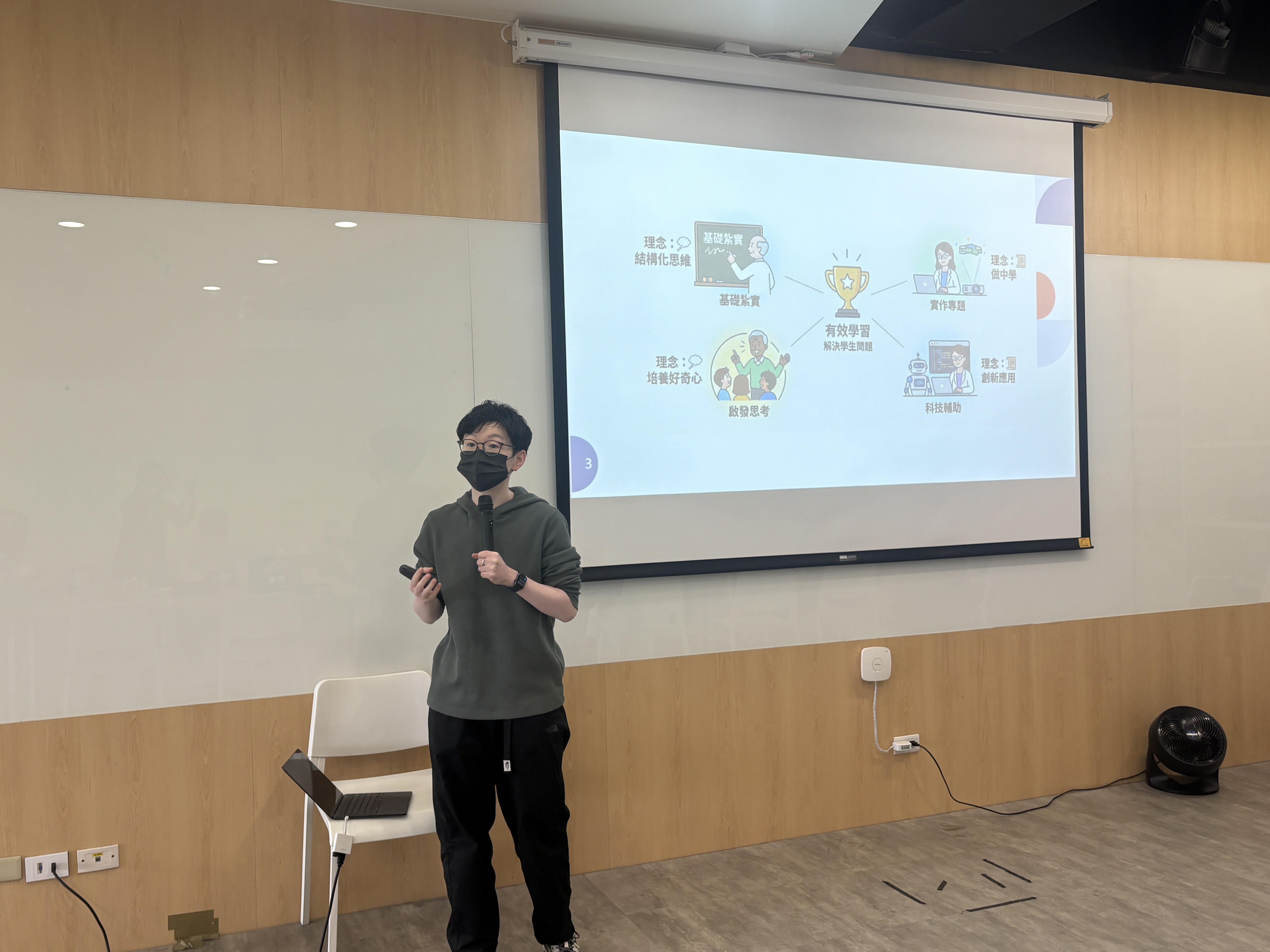
In the classroom, every instructor has their own methodology. However, teaching that truly guides students toward "mastery" goes beyond mere content delivery; the key lies in effectively responding to students' actual needs.
Professor Yi-Ju Tseng from the Department of Computer Science at National Yang Ming Chiao Tung University (NYCU) shared her experiences and teaching research projects at a recent faculty seminar. She discussed how to build more effective classroom environments and learning strategies by starting with "identifying student problems."
From "Teaching Well" to "Learning Well"
Professor Tseng emphasized that all pedagogical methods—whether traditional lectures, interactive learning, flipped classrooms, or tech-assisted instruction—are worth adopting as long as they genuinely help students. She pointed out that many instructors tend to focus on "how I teach," but truly effective teaching requires reverse thinking: starting with the students' obstacles. Which students are falling behind? Which ones find the material dull?
She also offered a reminder: "High student ratings do not necessarily mean you have solved the underlying problems." Teaching effectiveness should not rely solely on subjective feelings; one must be able to articulate how their specific methods improve the learning condition.
Identifying Obstacles: The Starting Point for Statistics Course Reform
Using her Statistics course as an example, Professor Tseng illustrated how "student pain points" can trigger curriculum redesign. Statistics is often perceived by students as boring and impractical. Furthermore, as the course is taught in English (EMI), many students expressed that learning in Mandarin would be easier. These insights became the core rationale for her redesign.
She identified three primary issues: lack of motivation, difficulty connecting statistical concepts to the real world, and the cognitive load of learning in English. To address these, she designed a comprehensive teaching model and validated it through the Ministry of Education's Teaching Practice Research Program.
Three Key Teaching Strategies: Student-Centered Design
- Preview Videos × In-Class Application: Enhancing Engagement and Self-Pacing By using a "pre-recorded videos + in-class application" model, Professor Tseng allows students to encounter core concepts before class, freeing up class time for hands-on practice and discussion. This allows students to digest content at their own pace and significantly boosts classroom participation. She joked that while recording videos is time-consuming, they can be used for years, making it a worthwhile long-term investment.
- PBL (Problem-Based Learning): Bringing Statistics into the Real World To break the stereotype that statistics is "abstract," she designed exercises based on real-world scenarios. For example: analyzing the success rates of different devices and networks when booking concert tickets; exploring travel behavior differences among various MBTI types; or analyzing data patterns behind Instagram trends. Students no longer just calculate numbers; they use statistical tools to answer "real-life questions."
- Increasing Participation: Reducing EMI Anxiety Professor Tseng cited research showing that as student engagement increases, the anxiety caused by English-medium instruction decreases. Consequently, her classes require group problem-solving where she and TAs circulate the room to provide immediate support. She also established a fixed cycle for every session: Pre-test → Group Problem Solving → Post-test. This predictable rhythm provides students with a sense of security and encourages focus.
Results After Reform: Visible Changes in Learning
Through multi-dimensional data analysis, Professor Tseng illustrated the concrete outcomes of the course. A significant increase in post-test scores provided direct evidence of the curriculum's effectiveness in knowledge transfer. Furthermore, analysis showed a positive correlation between classroom participation and final exam performance, highlighting the importance of active interaction.
Regarding digital resources, while students noted they couldn't ask questions during videos, their overall understanding improved significantly through the integration of in-class exercises. They progressed from "not knowing what statistics is for" to "being able to use statistics to answer life's questions." Qualitative interviews also revealed that "hands-on practice" and "immediate access to help" were the two most helpful factors, though some students noted pressure from the high volume of problems.
The Mindset of Teaching: It's Not the Method, It's the "Willingness to Change"
Throughout her talk, Professor Tseng repeatedly emphasized: "There is no single best teaching method, only the method that best fits the students." Instructors do not need to overhaul everything at once or possess flashy technology. She offered three suggestions:
- Adjust starting from where the students need it most.
- Review outcomes using evaluable metrics.
- Treat the classroom as a space for continuous improvement.
She also reminded colleagues that changes made by a teacher can help students regain confidence and feel understood and supported.
Professor Yi-Ju Tseng's experience serves as a reminder that teaching is not a solitary struggle. It is a collaborative process involving colleagues, teaching units, TAs, and the students themselves. In an era of rapid technological change, the most enduring value in education remains the teacher's courage and patience to understand and accompany students through their challenges.