AI Solutions for Complex Problems in Smart Cities
- Published on
- Author
- 林珮雯
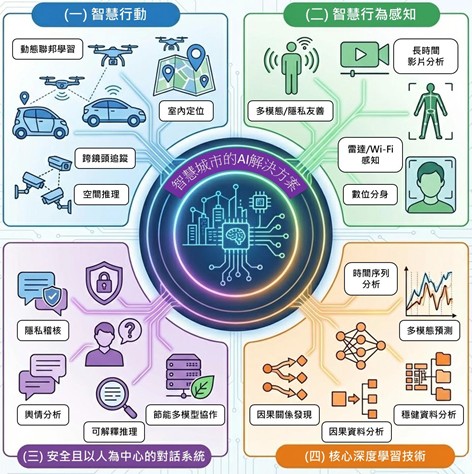
As the wave of urbanization continues to advance, the challenges faced by modern cities are no longer limited to population expansion and infrastructure growth. From traffic congestion, public safety, and energy dispatching to elderly care and digital governance, every issue directly impacts urban operational efficiency and the quality of life for residents. Behind these seemingly unrelated challenges lies a common thread: they are all accompanied by vast and rapidly changing data streams, such as video information, sensor data, geographical locations, communication signals, and citizen feedback. Relying on traditional manual management modes is no longer sufficient to cope with the fast-paced rhythm of contemporary cities. To this end, National Yang Ming Chiao Tung University has launched the "AI Solutions for Complex Problems in Smart Cities" project. By integrating cross-disciplinary expertise in computer science, intelligent computing, and electrical engineering, the project focuses on smart mobility, intelligent behavioral sensing, and secure, trustworthy intelligent dialogue systems, striving to create city-level AI technologies that are both forward-looking and practical.
In the field of smart mobility, the team is redefining urban flow through technology. By leveraging Wi-Fi signals, geomagnetic information, and multi-modal sensor data, they have established high-precision indoor positioning models. In scenarios where data is missing, AI is employed for estimation and completion, significantly reducing manual setup costs. This technology can be widely applied in hospitals, department stores, underground parking lots, and major transit hubs, helping citizens reach their destinations quickly while making venue management more efficient and flexible. Furthermore, the team has developed multi-camera tracking technology, breaking the limitations of traditional surveillance systems that cannot continuously identify the same person or vehicle across different cameras. Through spatial understanding and trajectory analysis, the system accurately captures the pulse of pedestrian and vehicle flows, injecting higher-level intelligence into traffic management, public safety, and large-scale event coordination.
Regarding intelligent behavioral sensing, the research team has further empowered cities with the ability to "understand human behavior." Through long-duration video analysis technology, AI can not only see the images but also gain insight into the context of events and detect early signs of anomalies—such as falls, conflicts, or dangerous gatherings—assisting relevant authorities in early intervention and rapid response. Despite the convenience, the team recognizes the high privacy concerns surrounding such technology. Consequently, the project actively develops privacy-preserving sensing technologies, such as millimeter-wave (mmWave) radar pose analysis and Wi-Fi signal behavioral recognition, which can detect human movements and activity states without the use of cameras. In the future, these technologies will be suitable for smart homes, medical institutions, and long-term care centers, guarding the safety of the elderly in real-time while protecting individual privacy, thereby enhancing care quality and living dignity while demonstrating the human-centric core values of smart cities.
On the level of citizen services, the project introduces Large Language Model (LLM) technology to build secure and trustworthy intelligent dialogue systems. In the future, citizens will be able to use natural language to easily query traffic information, parking availability, subsidy application processes, or the usage of public facilities, bringing digital services closer to daily life. To prevent AI from generating incorrect information or creating privacy risks, the team is simultaneously developing technologies for data source auditing, reasoning quality optimization, and energy-efficient multi-model collaboration. This ensures system responses are more accurate, transparent, and suitable for deployment in government and corporate service environments. When technology is no longer cold and inaccessible but interacts with people in a natural and trustworthy way, the vision of a smart city truly becomes a reality for its citizens.
Another highlight of this project lies in its strong emphasis on industry-academia cooperation and practical verification. Relevant results have been gradually applied in fields such as smart manufacturing, smart auto insurance, water quality monitoring, medical imaging, and multi-modal sensing, ensuring that research outcomes transcend laboratories and papers to enter industrial sites and respond to social needs. By having enterprises provide real-world problems and application scenarios while academia contributes cutting-edge technology and R&D energy, a complementary innovation cycle is formed. This process also cultivates a new generation of talent equipped with both theoretical foundations and practical abilities.
Ultimately, the value of a smart city lies not in the amount of equipment installed or the number of systems introduced, but in whether technology truly improves people's lives. This Academic Summit Program, supported by the National Science and Technology Council (NSTC), demonstrates the strength of Taiwan's research teams in transforming cutting-edge technology into social impact. When AI can help alleviate traffic pressure, enhance public safety, guard an aging society, promote industrial efficiency, and allow citizens to obtain services more conveniently, the "Smart City" is no longer just a concept on paper; it is a blueprint for life evolution that is being realized step by step. As industry-academia cooperation continues to deepen and technical applications continue to land, artificial intelligence is poised to become the most solid driver of sustainable urban development in the near future.