Alumnus Chang-Yu Tsai: From NCTU Computer Science to the Front Lines of Smart
- Published on
- Author
- 林珮雯
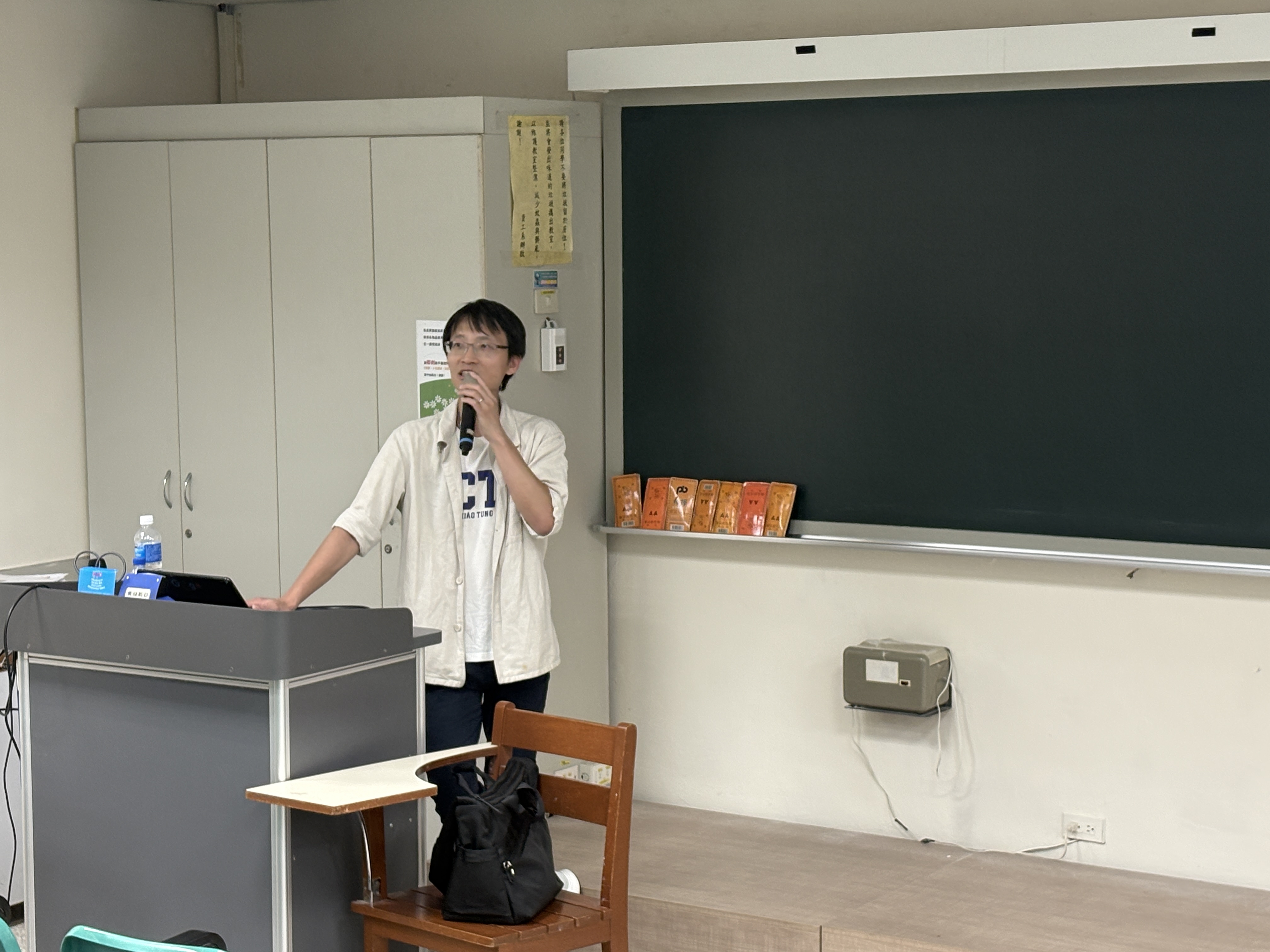 Twenty years after graduating from the Department of Computer Science at National Chiao Tung University (NCTU), Chang-Yu Tsai returned to campus. Sharing his journey under the theme "Doing Things, Doing the Right Things, and Doing Things That Last," he detailed his career path from NCTU Computer Science to the smart manufacturing industry. Unlike many computer science graduate who pursue careers in software or internet industries, Tsai chose instead to build his career in the machine tool and smart manufacturing sectors. Over his 18 years at Syntec Technology, he has cycled through roles in R&D, product development, IT, sales, and management, witnessing firsthand Taiwan's smart manufacturing evolution from automation to AI integration.
At the start of his speech, Tsai jokingly admitted that during his time at NCTU, he was "far more dedicated to extracurricular activities than about his coursework. " From winning first place as a director in the Chancellor's Cup competition and serving as the general coordinator for the CS Camp, to acting as the general coordinator for the Meichu Games and captain of the department volleyball team, he was involved in nearly every major student event. He openly acknowledged that his grades weren't outstanding back then, "but looking back now, what truly trained me were the processes of solving those problems." He believes his extensive student activity experience taught him early on how to define problems, break down goals, integrate resources, and make decisions under pressure—all of which became vital assets when he entered the industry.
After graduation, Tsai joined Syntec Technology, starting as an entry-level R&D engineer. At the time, the company had only 30 to 40 employees; today, its workforce across the Taiwan Strait now exceeds 1,600. He rose from a lone engineer to senior manager of the R&D Department II, managing teams of over 100 people at his peak, and even participated in internal corporate entrepreneurship and the founding of new subsidiaries. He noted that the most unique aspect of the smart manufacturing industry is that "engineers who develop controllers need to understand almost every part of the system. " Because the controller sits at the heart of the equipment, engineers cannot just understand software and hardware; they must comprehend how the end-user production lines actually machine, produce, and operate.
Using the machine tool industry as an example, Tsai explained that every piece of equipment in a modern factory requires a controller to operate, and Syntec Technology is one of Taiwan's leading controller manufacturers. From lathes and milling machines to robotics and automation equipment, everything relies on real-time computing, sensor data integration, and motion control technology. He pointed out that while industrial automation in the past mostly focused on "making the machines move, " modern smart manufacturing prioritizes "how machines can optimize themselves autonomously. " Consequently, AI is now making its way into real manufacturing environments.
Tsai shared one of the critical directions his team is currently pursuing: utilizing AI for CNC parameter tuning. Traditional equipment tuning relies heavily on the experience of experienced technicians, and it can take days or even weeks to optimally tune a single machine. However, by using sensors to gather data on vibration, speed, and machining errors, and combining that with AI models and digital twin technology, the optimal parameter combination can be identified rapidly. He described it as: "Things that used to require years of experience to accomplish can now be achieved by far more people thanks to AI."
"Smart manufacturing isn't just about AI models; the real challenge lies in the physical world." Tsai emphasized. On the factory floor, variables such as temperature, humidity, materials, and equipment conditions all affect the machining outcomes. Therefore, smart manufacturing is not a pure software issue, but a cross-disciplinary engineering challenge that integrates information technology, mechanical engineering, control systems, and manufacturing processes.
Because of this complexity, Tsai believes that computer science students from NCTU are actually exceptionally well-suited for the smart manufacturing industry. The systems thinking and problem-solving skills cultivated by a computer science background can deliver immense value to the sector. However, he reminded students not to focus solely on the technology itself, but to understand the actual needs and pain points. "Often, the hardest part is not the method, but figuring out exactly what problem you are trying to solve. "
In the latter half of his speech, Tsai further shared insights gleaned from his 20-year career, offering five key takeaways: "Problems matter more than methods; systems matter more than features; implementation matters more than demos; the long term matters more than the short term; and resilience matters more than sprinting. " In his view, the biggest difference between academic research and industry is that industry ultimately demands real-world implementation. A solution only holds value if it can actually be deployed on the factory floor and operate stably.
For the many graduate students about to enter the workforce, he also offered a piece of advice: "There is no such thing as the best choice, only the choice that suits you best. " He candidly remarked that most people do not truly know themselves initially, so they should start by doing and trying different things, gradually getting to know themselves along the way. Viewing a career as a long journey, he urged, "Don't be too afraid of change, " because what truly matters is the ability to keep growing and to find a direction you are willing to commit to for the long haul.
From an NCTU computer science student to a key driver in the smart manufacturing industry, Chang-Yu Tsai's journey is more than just a personal career story; it mirrors Taiwan's manufacturing sector as it transitions from traditional automation to AI-driven smart manufacturing. For the students in attendance, this lecture was not merely a technical showcase, but an inspiring lesson in industry vision and long-term personal growth.