Lessons from NYCU: Alumnus Nei-Chiung Perng's Life and How to Navigate the AI Era
- Published on
- Author
- 張怡婷
Lessons from NYCU: Alumnus Nei-Chiung Perng's Life and How to Navigate the AI Era
Alumnus Nei-Chiung Perng, who received his B.S. in Information Science in 1999 and M.S. in 2001 from NYCU (formerly National Chiao Tung University), embodies the journey of a computer scientist navigating the waves of technological change. During his time at school, he served as President of the Information Science Department Student Association and President of the Student Union, and was selected as an Outstanding University Youth and a YEF (Young Entrepreneurs of the Future) representative. He even represented the university as a training athlete for the ACM Asia Regional Programming Contest in 1994. Yet, this engineer with a deep background in computer science surprisingly began his career with the phrase, "I hate hardware the most," only to find his first job was in an IC design company, handling information processing and AI-related tasks.
While working at the prestigious Intel, Perng led a life many envied, reminiscent of "Up in the Air," where he could arrive at the airport just two hours before boarding and still make his flight, thanks to various VIP cards. However, a conversation with AppWorks founder Alumnus Nathan Chiu completely altered his trajectory. Lin asked him, "If software people like you hide inside hardware companies, how can Taiwan's software industry have a future?" Although Perng jokingly regrets that the two biggest regrets in his life are pursuing a Ph.D. and starting a business because both were time-consuming and had a low cost-performance ratio (CP value), he ultimately chose to "bare-bones resign" and decided to fight for his future. Shortly after founding DeepSight Innovation (雲深創新), Nathan Chiu shifted his focus to AppWorks, which became the sole agent for Facebook in Taiwan, generating NT$2 billion in annual business, thus inadvertently making Nei-Chiung Perng the CEO of DeepSight Innovation.
DeepSight Innovation operates discreetly, earning the nickname "The Cloud is Deep, the Location Unknown" (雲深不知處). Its core business lies in the research and application of recommendation systems. The company's application fields are extensive, ranging from recommendations for news, products, videos, to banking and insurance products. More impressively, DeepSight Innovation demonstrated a successful business model that integrates software intelligence with hardware. For example, their famous pet camera, Furball, has kept the same hardware for years but continuously updates its functions through software—enabling facial recognition, emotion detection, and treat dispensing—achieving astonishing annual revenues. Perng points out that the number of pets in Taiwan now exceeds the number of newborns, proving that even by selling only hardware, one can earn substantial profits through software innovation. Furthermore, DeepSight Innovation participated in the data processing system for the 2024 Premier12 baseball tournament—the "Flamesight Intelligence Gathering System"—providing professional data analysis services that helped Taiwan successfully secure the world championship.
When discussing entrepreneurship, Perng spoke earnestly, advising people not to start a business just for the sake of it; one must first know how to make money and what one truly wants to do. The success rate for startups in Taiwan is only 1%, but this does not mean avoiding challenges. In this rapidly changing era, the stable job model of the past has vanished; many large companies like Nokia and MSN could collapse at any moment, and people can work hard yet still face unemployment. Therefore, the true driving force for entrepreneurship is the passion to realize an internal goal, whether it's building a robot or a flying car—this passion is the only way to turn an idea into reality.
Navigating the advent of the AI era is the core of Perng 's sharing. He compares the current AI situation to the rise of the World Wide Web in 1995, when many people felt the internet was useless until the emergence of the hyperlink changed the world. AI development has also gone through several waves, from symbolic logic in the 1950s to expert systems in the 1980s, and now to deep learning. Perng believes that the development of Large Language Models (LLMs) has entered the "Warring States Period", where models train on each other's data, causing their answers to become increasingly similar, much like historical royal "intermarriage." This signifies that the competition in AI development will enter a deeper, more sophisticated level.
Regarding the constraint on AI chips, Perng offers an intriguing perspective: just as engineers conserved memory when computing resources were scarce in the past, when China's computing power is restricted today, their algorithms may become more powerful through "compute conservation," because "life finds a way." Therefore, perhaps we should "use American hardware and learn Chinese algorithms."
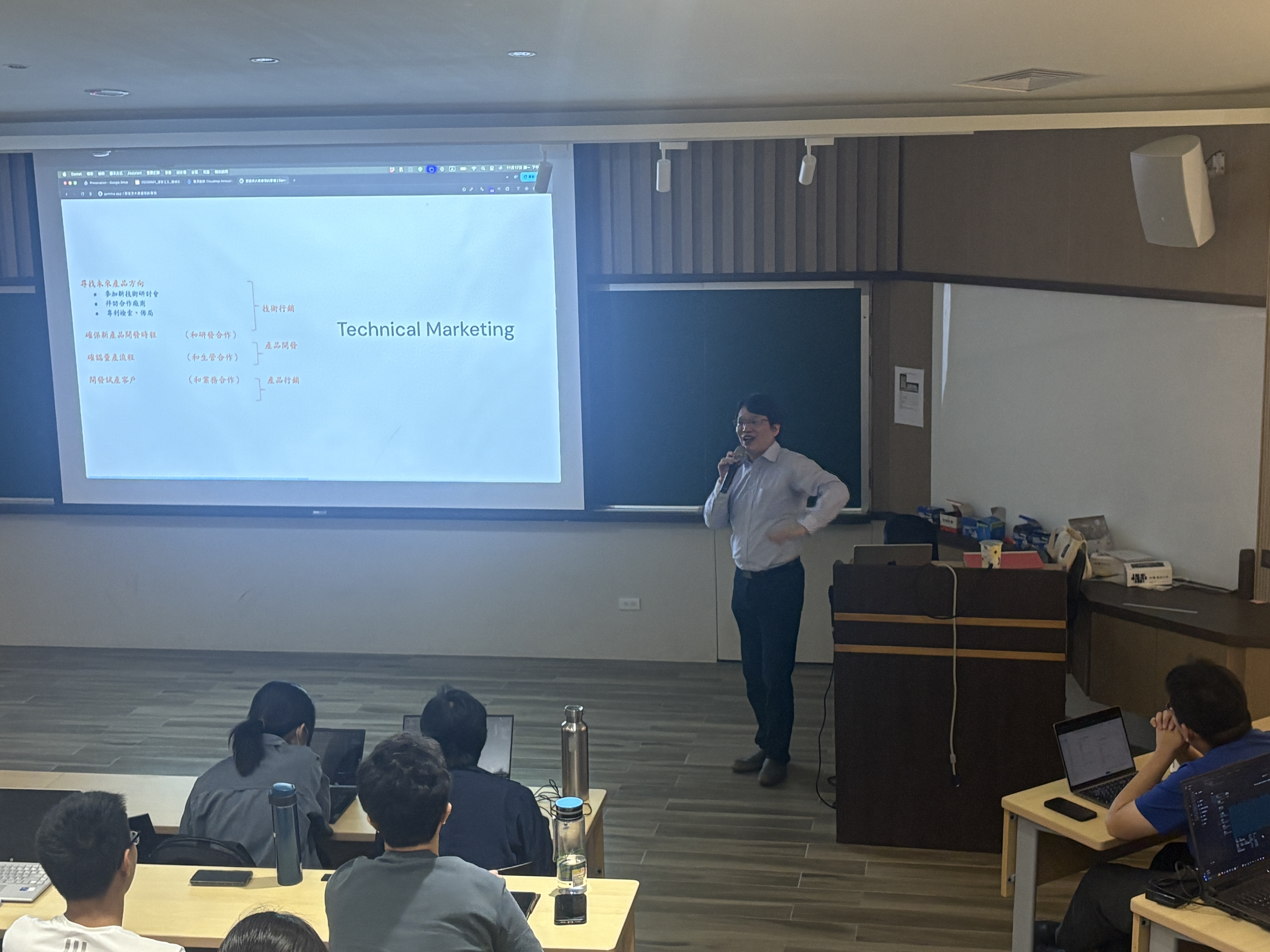
Facing this era, the alumnus offers his most valuable advice to computer science students: "Learn the 'methods', not the 'tricks'." He emphasizes that the only constant in the IT world is change itself; the knowledge learned today will surely be useless in ten years. Therefore, the important thing is not mastering specific technologies but learning methodologies and the ability to learn systematically. Even regarding popular topics like AI coding or debugging, Perng reminds us that the core value of a computer science student is not just writing code or debugging, but analyzing system bottlenecks and determining good solutions. He believes that with the rise of Spec Driven Development (SDD), future engineers will collaboratively define specifications (specs) with AI, and then let the AI complete high-quality code, because "humans can't write good specs, which is why AI-written code often acts weirdly."
Perng's own journey proves the importance of continuous learning; at 48, he is still actively studying AI because IT professionals must "learn quickly and forget quickly," always ready to absorb new things. Finally, he encourages everyone to participate in competitions like the YEF startup contest to try and understand the world from different perspectives, and warmly reminds all his juniors to make good use of their time, sharpen their skills, and never forget their passion.