Cross-Disciplinary Research Team Develops "High-Efficiency Distributed Propulsion VTOL UAV" Technology, Creating New Heights in Smart Flight
- Published on
- Author
- 張怡婷
Cross-Disciplinary Research Team Develops "High-Efficiency Distributed Propulsion VTOL UAV" Technology
Creating New Heights in Smart Flight
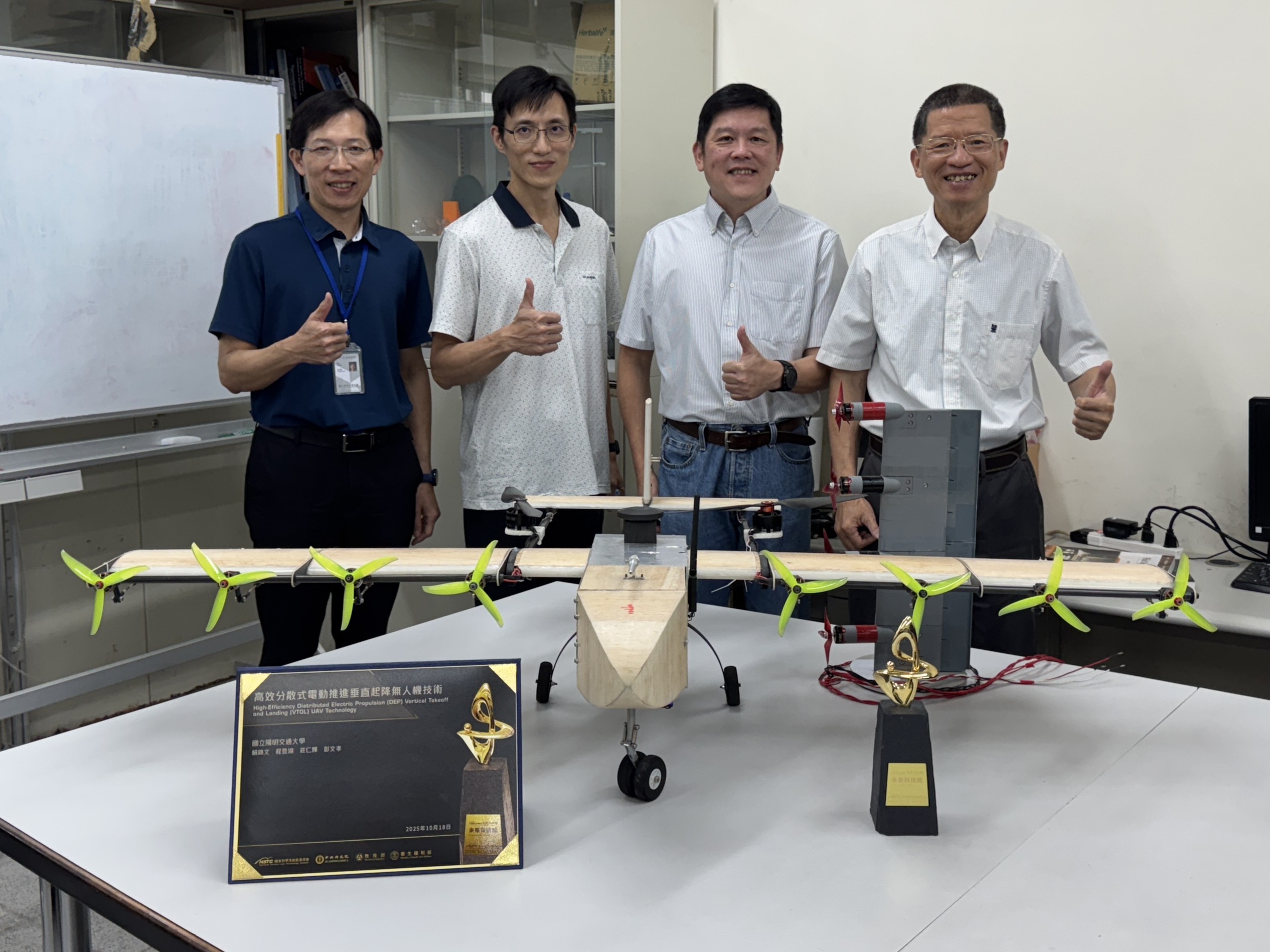
A cross-disciplinary research team led by Professor Jen-Hui Chuang of the Department of Computer Science at National Yang Ming Chiao Tung University (NYCU), along with Professors Lua Kim Boon, Teng-Hu Cheng, and Wen-Hsiao Peng, won the 2025 "Future Tech Award" for their "High-Efficiency Distributed Electric Propulsion Vertical Takeoff and Landing (VTOL) UAV Technology." This technology is a core output of the Ministry of Science and Technology's "Resilient Homeland – Smart Safety Environment and Disaster Prevention System Constructed with Smart UAVs" project. It not only enhances the UAV's endurance and stability but also opens up new possibilities for Urban Air Mobility (UAM) and disaster response applications.
Breaking Traditional Design Frameworks: Innovative Propulsion Technology Enhances Flight Efficiency
The team broke through the design limitation of traditional Vertical Takeoff and Landing (VTOL) UAVs, which require two separate propulsion systems, by proposing a "Distributed Electric Propulsion (DEP)" architecture. The system combines controllable pitch propeller modules with a servo control mechanism, enabling a single platform to perform multi-mode flight, including takeoff, hovering, transition, and high-speed cruising. This significantly reduces structural weight, lowers drag, and improves energy efficiency. This innovation demonstrates Taiwan's independent R&D capabilities in high-level aerodynamic control.
In wind tunnel experiments and numerical simulations, the wake generated by the distributed propellers guides the airflow to closely adhere to the main wing surface, delaying boundary layer separation and suppressing stall, resulting in a more than three-fold increase in the lift coefficient. The team further optimized propeller size and configuration to improve the lift-to-drag ratio and flow field uniformity. The counter-rotating wingtip design weakens vortices and reduces induced drag, making the overall flight more stable and energy-efficient.
AI Smart Control: Making UAVs Smarter and Safer
In addition to structural innovation, the team incorporated an AI sensing and decision-making system, enabling the UAV to possess real-time environmental awareness and autonomous flight capabilities. The system can dynamically adjust the thrust direction and rotational speed distribution based on airflow changes and mission requirements to maintain a stable flight attitude, making it particularly suitable for sudden weather changes or complex terrain. Intelligent control allows the UAV to perform high-risk tasks in disaster sites or low-altitude urban environments, balancing safety and efficiency.
Modular design is another key feature. Each propulsion module can be independently controlled and quickly maintained, allowing for flexible configuration adjustments based on mission payload, giving it high expandability and cross-platform integration potential. The all-electric drive structure also boasts advantages such as low noise, zero emissions, and simple maintenance, aligning with global net-zero and green aviation development trends.
Multi-Domain Applications: From Smart Cities to Disaster Relief
This technology, with its advantages of high endurance, high stability, and multi-mode control, can be widely applied in fields such as Urban Air Mobility, disaster relief, and energy inspection.
- Urban Air Mobility (UAM): It can serve as a core vehicle for short-range shuttle services, air taxis, and low-altitude logistics, offering both low noise and high safety features.
- Disaster Response: The system can autonomously identify mission requirements and quickly deploy to areas with disrupted traffic or difficult terrain to perform aerial photography, transportation, and communication tasks.
- Inspections and Monitoring: This technology can also support smart agriculture and energy facility inspection, carrying sensors and AI edge computing modules for farmland monitoring, crop analysis, wind farm, and power tower inspection. Furthermore, it can combine GPS and visual navigation for high-efficiency patrol and material transport in remote areas and national defense monitoring missions, showcasing the potential for Taiwan's independent disaster prevention technology applications.
Patent Innovation Establishes Independent R&D Technical Advantage
This technology was granted an invention patent (Certificate No.: TWI890115B) by the Intellectual Property Office in July 2025, titled "Fixed-Wing UAV and its Propeller Assembly." The system uses a servo motor to drive a rod mechanism, axially rotating to adjust the propeller direction, automatically changing the thrust vector according to different flight modes. The propeller modules are distributed along the wing's leading edge and can instantaneously fine-tune their angle based on airflow conditions, providing both energy-saving and stability benefits. This innovative structure breaks the limitations of fixed-wing UAVs in VTOL and transition flight, laying the core foundation for the team's "Distributed Electric Propulsion" system
Cross-Disciplinary Integration: Building a Next-Generation Smart Flight Platform
This team, integrating expertise from computer science, mechanical design, control systems, and artificial intelligence, showcases NYCU's R&D strength in cross-disciplinary innovation. The team's core philosophy is "to propel a green aviation future with intelligence," hoping to establish a practical technology platform for next-generation air mobility and disaster response applications through innovative distributed propulsion and AI decision-making systems.
From Research to Practice: Opening a New Chapter in Green Aviation
Winning the "Future Tech Award" not only affirms NYCU's R&D achievements in smart aviation and AI applications but also symbolizes the campus's research energy moving towards practical application and international alignment. The technology provides a critical solution for next-generation smart air transport, and is expected to have a far-reaching impact in diverse fields such as urban traffic, disaster relief, energy monitoring, and sustainable development.