News

2026 CS Alumni Homecoming: Collaboratively Leading a New Blueprint for the AI Era

Published on
Author
林珮雯

2026 CS Alumni Homecoming: Collaboratively Leading a New Blueprint for the AI Era

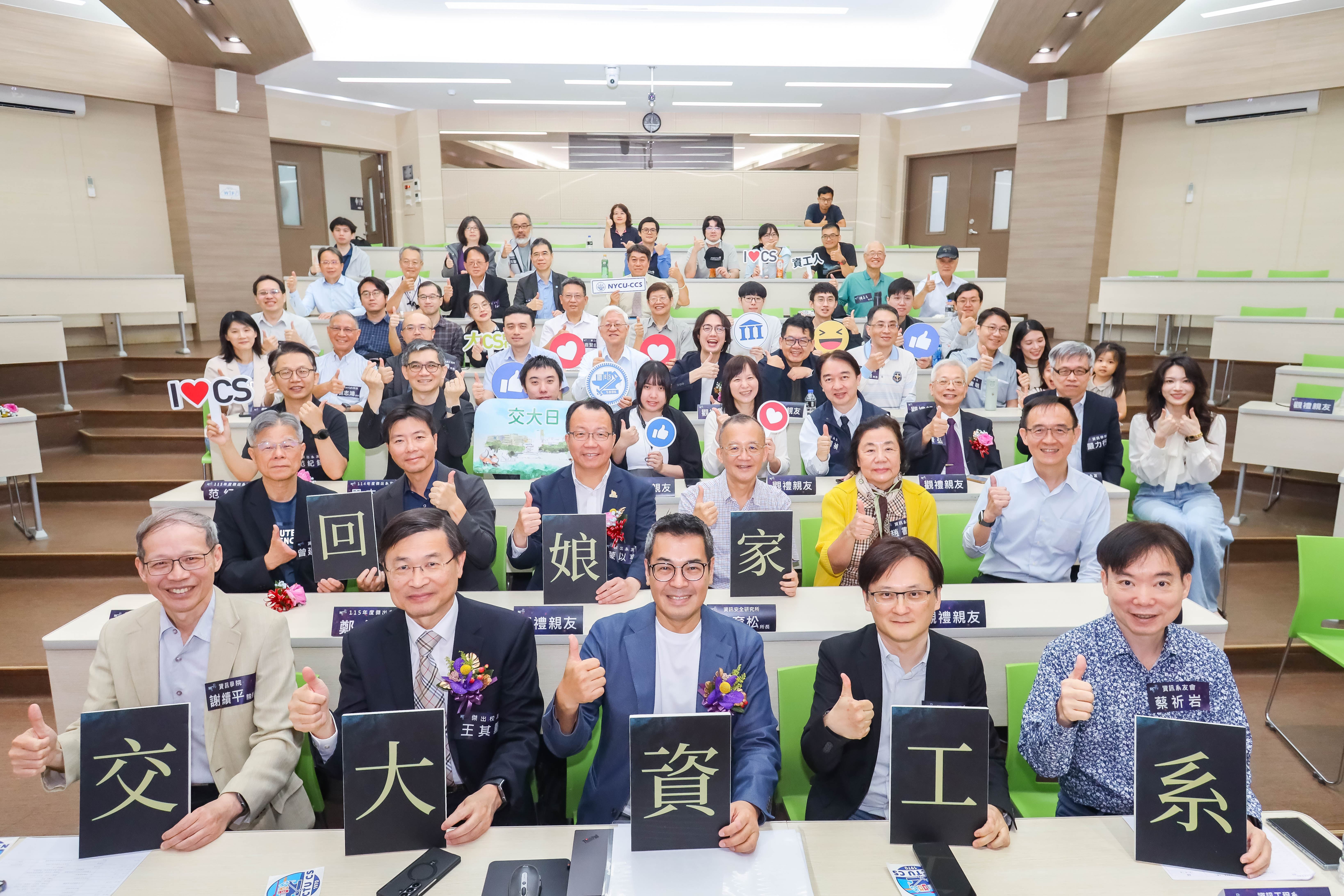
In the warm and blossoming month of April, the Department of Computer Science at National Yang Ming Chiao Tung University (NYCU) hosted its annual "CS Alumni Homecoming" in conjunction with the "Chiao Tung University Day" series of events. This gathering invited alumni from various generations to return to campus to participate in the Distinguished Alumni Awards Ceremony and exchange activities. This year, the event not only honored benchmark exemplars who have dedicated themselves to deep cultivation and outstanding performance across industry and academia, but also demonstrated the talent strength and influence accumulated by NYCU CS over the years in the tech sector through their valuable experience sharing.

"If everyone walked in today from Engineering Building III, you would see the ox pulling a vacuum tube computer, which was the very first computer in Taiwan. Furthermore, the Computer Museum in the basement records precious milestones such as the first Chinese keyboard and the first Convex computer," proudly pointed out Dr. Shiuh-Pyng Shieh, Dean of the College of Computer Science. He emphasized that the CS department at Chiao Tung University was the first computer science department in the nation, carrying the glory and history of the development of Taiwan's information industry. The Dean also expressed a special hope that a closer connection could be established between alumni and current students through this event, collaboratively continuing the spirit and inheritance of CS people, and stepping forward together to lead development in the AI wave.

Inspirational Wisdom and the Passing of the Torch

Following Dean Shieh's wonderful opening remarks, the two exceptional alumni honored with this year's Distinguished Alumni Award took the stage sequentially to share their career journeys and international perspectives.

The first to present was Kee Ong, a distinguished alumnus who graduated with his BS degree in Computer Science and Engineering in 1989. Having lived abroad for more than thirty years, his career has spanned research and development, marketing, sales, and executive management, with his footprints reaching the United Kingdom and Australia. Ong humbly credited this honor to his classmates who worked hard alongside him back then, and further shared his deep observations on the international stage. He pointed out that when Taiwanese businesses expand overseas, they often face numerous challenges due to political backgrounds, making "citizen diplomacy" exceptionally crucial. The key to successful citizen diplomacy lies in language proficiency and empathy, as an effective communication bridge can only be built by truly understanding the local culture and educational background. Furthermore, standing at the forefront of technology promotion, Ong felt deeply about the rapid development of AI technology in recent years. Referencing Jensen Huang's "half-cake" theory, he reminded current students that AI will completely transform working styles and learning methods in the next five to ten years. If one cannot master the most cutting-edge application trends, they may face the risk of being eliminated by the times. Therefore, he encouraged everyone to actively engage in this tech wave, continuously learn and self-improve, and stand firm in a rapidly changing era.

Following him was Ryan Lee, a distinguished alumnus who received his BS degree in Computer Science and Engineering in 1990 and his MS degree in Computer Science in 1993. With his personal journey, he showcased a legendary and cross-disciplinary entrepreneurial life. Lee recalled that the deep camaraderie built with his peers in Dorm 7 during his college days, along with the experience of the entire class collaboratively taking on a million-dollar project during a summer vacation, became vital inspirations for his subsequent entrepreneurial ventures. After graduation, he resolutely followed his passion into the music industry, composing songs for well-known singers such as Mavis Fan and Dave Wang, and rising to the position of music director. When the physical record industry was impacted by the wave of digitization, Lee keenly adapted to market changes, involving himself in the development of online platforms such as Wretch and PIXNET, and later went to Mainland China to learn investment. Upon returning to Taiwan, he established a fund to assist domestic small and medium enterprises in implementing digital management, successfully turning a local pet supply chain profitable and driving it through an IPO to get listed on the stock market, which eventually attracted investment from the Uni-President Group. Lee admitted that he was not the most top-tier student during his school days, but he always believed that the thinking methodologies and professional capabilities trained during his graduate studies became an important foundation that benefited him for a lifetime. He also encouraged younger students to bravely explore their own possibilities in the drastically changing AI era, maintain passion, cultivate sharp market observation, and seize every opportunity brought by the times. Concurrently, he looked forward to continuing to give back to his alma mater and contributing to the development of the College of Computer Science.

Honoring Excellence and Inspiring Role Models

This year, a total of nine distinguished alumni were recognized. They have deeply cultivated the industry, academia, and research fields for a long time, leveraging their excellent professional capabilities and forward-looking vision to achieve brilliant accomplishments in their respective arenas. In addition to continuously driving technological innovation and industrial development, they have also taken concrete actions to give back to society, fully demonstrating the spirit and value of NYCU CS people in bravely pioneering and contributing what they have learned.

Among the awardees, Jing-Hong Wang, who received his MS degree in Computer Science in 1990 and his PhD degree in Computer Science in 1997, currently serves as the Vice President of the Chunghwa Telecom Laboratories and concurrently holds the position of Director at Kingwaytek Technology Co., Ltd. He has long cultivated the R&D of cutting-edge technologies, focusing on exploring emerging business layouts and vigorously driving the incubation of R&D startups, with his outstanding management and technical strength earning him the dual honors of Chunghwa Telecom's Outstanding Management Executive of the Year and Top Ten Outstanding Employees of the Year.

Jenny Hu, who earned her BS degree in Computer Science and Engineering in 1997, is the Deputy Director of the Corporate System Integration Division at TSMC. She has excelled in the integration and optimization of TSMC's manufacturing information systems for years and actively participates in the Women@TSMC organization to leverage female tech leadership, while also enthusiastically giving back to her alma mater by actively pushing for TSMC experts to return to campus in 2022 to open the "Cloud-Native Software" course to cultivate students' core practical skills.

Paul Fan, who completed his MS degree in Computer Science and Information Engineering in 2002, is the VP of Engineering and Taiwan Managing Director at Circle. As the founder of CYBAVO, a top-tier blockchain cybersecurity enterprise, he successfully led the company to be acquired by Circle, the globally renowned issuer of the stablecoin USDC, relying on world-leading digital asset custody technology and successfully propelling Taiwan's tech strength onto the international stage.

Juei-Ting Weng, who graduated with his MS degree in Computer Science and Information Engineering in 2010, currently serves as the Community Lead at FINOLAB Inc. in Japan. He was a pioneer in online video startups, co-founding CHOCO TV and serving as the COO of LINE TV, and in recent years has extended his reach overseas, deeply cultivating the FinTech ecosystem in Tokyo and actively linking innovation industry resources between Taiwan and Japan.

Hung-Chi Hsu, who obtained his BS degree in Computer Science and Engineering in 1991 and his MS degree in Computer Science in 1993, is the General Director of the Information Technology Services Division at ITRI. He has long focused on the research, development, and deepening of core network communication technologies, accumulating technology transfers to more than thirty domestic network communication manufacturers and successfully building high-specification national and enterprise-level cybersecurity defense architectures, sparing no effort in protecting corporate digital assets and driving industrial digital transformation.

Chun-Ming Chen, who received his BS degree in Computer Science and Engineering in 2002 and his MS degree in Computer Science and Information Engineering in 2004, serves as a Director and the Manager of the Optical Computing Laboratory at Largan Precision Co., Ltd. He previously served as a software engineer at Google Headquarters in the United States, possessing profound international tech experience, and currently spearheads the digital transformation of Largan Precision's optical R&D processes, perfectly fusing cutting-edge information technology with traditional precision optics.

Gwo-Jen Hwang, who graduated with his BS degree in Computer Science and Engineering in 1985 and his PhD degree in Computer Science in 1991, is the Vice President of National Taichung University of Education. He has achieved outstanding accomplishments in the field of academic research, having received the Ministry of Education's Lantern Award and three NSCC/NSTC Outstanding Research Awards, and has been long selected for Stanford University's "World's Top 2% Scientists" list, ranking 1st in Taiwan and 7th globally in the field of education.

I Heng Meng, who earned his PhD degree in Computer Science in 2002, is the General Director of the Software Technology Institute at III. He has led his R&D team to win 14 international awards, including the R&D 100 and Edison Awards, striving to construct a trustworthy AI governance and third-party verification system, while substantively applying digital technology to remote area care and campus safety protection.

Yung-Pin Cheng, who completed his BS degree in Computer Science in 1989 and his MS degree in Computer Science in 1991, is a Professor in the Department of Computer Science and Information Engineering at National Central University and the Co-founder and CTO of IsCoolLab Co., Ltd. He has led the deep integration of the dual tracks of industry and academia, and relying on innovative automation and artificial intelligence technologies, has successively won multiple technical indicator awards, including the 2026 Business Weekly AI Innovation Top 100, the 2025 Presidential Hackathon AI Special Award, and the 2024 APICTA Awards Gold Trophy.

Forward-Looking Vision: Scaling New Heights Together

At the conclusion of the ceremony, Mr. Charles Chiu, Chairman of the Alumni Association, and Professor Li-Ping Chang, Chairman of the Department, delivered the final addresses, drawing a grand blueprint for the future development of computer science at NYCU.

Chairman Chiu warmly shared the three core missions of the alumni association: first, to build a bridge for cohesion and exchange, closely connecting CS people from Chiao Tung University at home and abroad through diverse dinners and networking activities; second, to act as a solid backing for the department, meaning that when the development of the academic department faces resource challenges, the alumni association will call upon outstanding alumni from all sectors to collaboratively provide abundant support; finally, to lead growth, as the alumni association will successively hold forward-looking lectures in May and June amidst the rapidly changing AI era to assist alumni in keeping pace with the times and continuing to grow.

In summarizing, Chairman Chang mentioned that the department has actively recruited excellent young scholars in recent years and established the "Youth Chair Professorship" and "Technology Chair Professorship" under the strong support of alumni donations, successfully enriching top-tier teaching and research capacity. The Chairman expressed his deepest gratitude for the selfless dedication of the alumni, particularly mentioning that alumnus Simon Lin from Wistron generously donated in his personal capacity to construct the "Hua-Jen Building," writing a brand-new record in the university's history for individual building donations. Under the exemplary leadership of past distinguished alumni, the strong cohesion of the alumni association, and the endless R&D innovation energy of the alma mater, the Department of Computer Science at NYCU will carry this commitment of bridging the past and the future to collaboratively scale another brilliant peak.