Building Strong English Skills: The College of Computer Science “English Roundtable” Supports Effective Student Communication
- Published on
- Author
- 林珮雯
Building Strong English Skills: The College of Computer Science “English Roundtable” Supports Effective Student Communication
Roy Chen / Institute of Teaching English to Speakers of Other Languages, NYCU
With an aim to strengthen the communication skills of graduate students in the College of Computer Science under an all-English learning environment at National Yang Ming Chiao Tung University, the Bilingual Education Task Force Team of the College of Computer Science once again launched the well-received activity "English Roundtable" in the first semester of the 114th academic year. This activity aims to provide students with an interactive and immersive English learning environment, ensuring that every participant has abundant opportunities to practice speaking English through in-depth guidance and structured teaching design in small group instruction, thereby enhancing students' confidence and ability to communicate in English.
This time, "English Roundtable" was moderated by Wendy, an EMI Specialist from the Higher Education Accreditation for Teaching (HEAT) at NYCU. The activity has a total of four sessions, each with two practical course trainings. The first class focused on solving common difficulties in English expression, such as insufficient vocabulary or not being able to construct ideas effectively. In order to help participants, overcome these difficulties, the lecturer introduced two frameworks: "1-2-3 Model (1 Answer-2 Reasons-3 Words to recap)" and "PPF Model (Past-Present-Future)" to help participants quickly organize their thoughts using specific thinking frameworks and chronological perspectives. At the same time, the "Frayer Model" was also introduced to guide students to analyze words through the four different quadrants: Definition, Characteristics, Examples, and Non-examples. This Frayer Model can help students break away from traditional rote memorization, and equip them with the ability to apply vocabulary in daily life after they truly understand the usage and context of words.
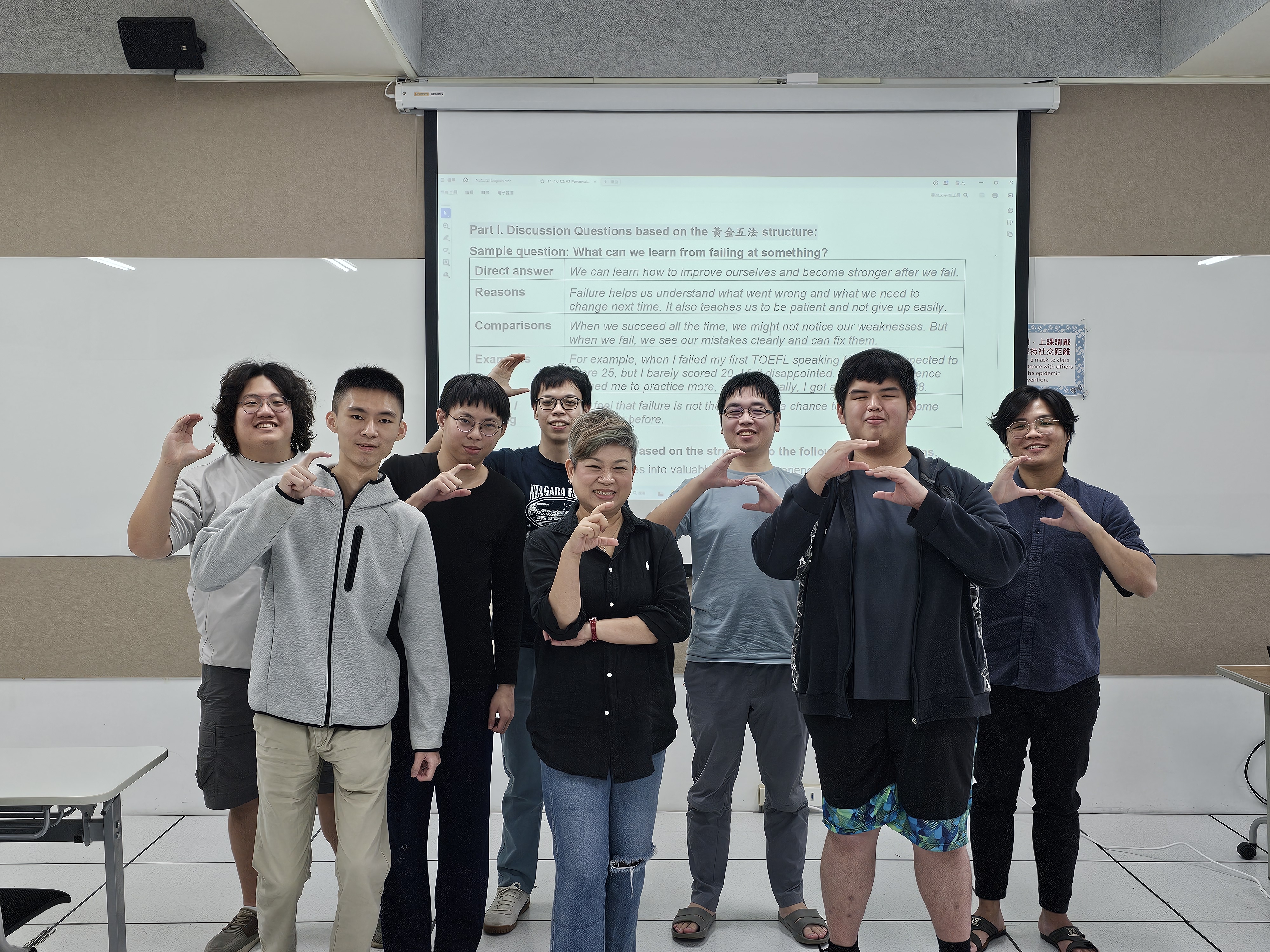
On the other hand, the second class focused on the training of "oral expression" and "rhetorical strategies", aiming to enable students to not only express themselves fluently in English, but also speak wonderfully. The lecturer guided students step by step using the "Golden Five Aspects" - Direct Answer, Reasons, Comparisons, Examples, and Feeling to help them provide more details on top of the initial short answers, thereby enriching the richness of content. In addition, to help students become more engaging and persuasive when presenting or sharing in class, the lecturer shared three major rhetorical strategies - "Storytelling", "Contrast" and "Using Questions" - to guide students on how to interact with the audience and make the content of the presentation more vivid.
- 「I learned very useful strategy to answer the question in detail, and like in a talk. I learned three rhetorical strategies, which including storytelling, contrast, using question. I believe that attending this lesson can help me improve the conversation, vocabulary, and so on.」、
- 「This is my first time to engage in this activity, and is also my first time to say so much English in front of so many people. I felt some stress, but also got a lot of progress. I feel so grateful.」
According to the results of the survey, the overall satisfaction rate of participants with this activity was as high as 4.58 points out of 5. Participants particularly gave a high rating (4.79 points) to the statement "The curriculum design increases my opportunities and willingness to speak English.", which means that this activity has successfully created a learning environment that encouraged experimentation, allowing participants to confidently share and communicate in English without worrying about making mistakes. In addition, participants also shared many valuable insights in their feedback, such as:
- "It was a very good activity, allowing me to practice speaking English more and get used to speaking on stage, and I hope to have more courses like this in the future."
- "It's a great opportunity to practice speaking and have a teacher to correct your grammar and speaking skills. In addition, the structured teaching, along with peer demonstrations and pair work, helps internalize these speaking skills."
- "I think this activity is the real way to learn English, at least it's much more interesting than learning grammar and doing the exercises."
- "Through this activity, I learned many practical communication and presentation skills, and both the instructor and my peers were very active and positive so that even those who are not familiar with speaking English can be willing to express their thoughts out loud in English, which is a very good opportunity to practice."
- 「I learned very useful strategy to answer the question in detail, and like in a talk. I learned three rhetorical strategies, which including storytelling, contrast, using question. I believe that attending this lesson can help me improve the conversation, vocabulary, and so on.」
- 「This is my first time to engage in this activity, and is also my first time to say so much English in front of so many people. I felt some stress, but also got a lot of progress. I feel so grateful.」
The above feedback reflects the lively and interactive learning environment provided by this "English Roundtable" activity, which has successfully received enthusiastic responses from participants. Overall, this activity not only provided valuable opportunities for English speaking practice but also improved participants' conceptual skills and English expression skills by introducing the "1-2-3 Model", "PPF Model", "Frayer Model", "Golden Five Aspects" and "Three Rhetorical Strategies". In the future, the Bilingual Education Task Force Team of the College of Computer Science will continue to launch English power-up activities that meet students' practical needs to cultivate more IT talents with international mobility and communication skills.