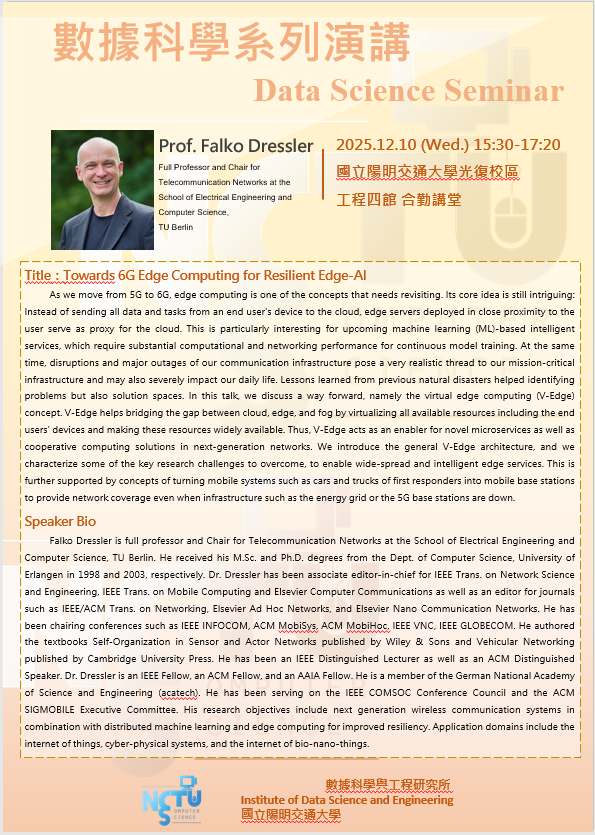
[數據科學系列演講] 2025.12.10 (Wed.) 15:30-17:20工程四館 合勤講堂 講題: Towards 6G Edge Computing for Resilient Edge-AI
- Published on
- Author
- 謝宛庭
數據科學系列演講Data Science Seminar
講題: Towards 6G Edge Computing for Resilient Edge-AI
日期: 2025.12.10 (Wed.) 15:30-17:20
地點: 工程四館 合勤講堂
講者: Prof. Falko Dressler
As we move from 5G to 6G, edge computing is one of the concepts that needs revisiting. Its core idea is still intriguing: Instead of sending all data and tasks from an end user's device to the cloud, edge servers deployed in close proximity to the user serve as proxy for the cloud. This is particularly interesting for upcoming machine learning (ML)-based intelligent services, which require substantial computational and networking performance for continuous model training. At the same time, disruptions and major outages of our communication infrastructure pose a very realistic thread to our mission-critical infrastructure and may also severely impact our daily life. Lessons learned from previous natural disasters helped identifying problems but also solution spaces. In this talk, we discuss a way forward, namely the virtual edge computing (V-Edge) concept. V-Edge helps bridging the gap between cloud, edge, and fog by virtualizing all available resources including the end users' devices and making these resources widely available. Thus, V-Edge acts as an enabler for novel microservices as well as cooperative computing solutions in next-generation networks. We introduce the general V-Edge architecture, and we characterize some of the key research challenges to overcome, to enable wide-spread and intelligent edge services. This is further supported by concepts of turning mobile systems such as cars and trucks of first responders into mobile base stations to provide network coverage even when infrastructure such as the energy grid or the 5G base stations are down.
Speaker Bio
Falko Dressler is full professor and Chair for Telecommunication Networks at the School of Electrical Engineering and Computer Science, TU Berlin. He received his M.Sc. and Ph.D. degrees from the Dept. of Computer Science, University of Erlangen in 1998 and 2003, respectively. Dr. Dressler has been associate editor-in-chief for IEEE Trans. on Network Science and Engineering, IEEE Trans. on Mobile Computing and Elsevier Computer Communications as well as an editor for journals such as IEEE/ACM Trans. on Networking, Elsevier Ad Hoc Networks, and Elsevier Nano Communication Networks. He has been chairing conferences such as IEEE INFOCOM, ACM MobiSys, ACM MobiHoc, IEEE VNC, IEEE GLOBECOM. He authored the textbooks Self-Organization in Sensor and Actor Networks published by Wiley & Sons and Vehicular Networking published by Cambridge University Press. He has been an IEEE Distinguished Lecturer as well as an ACM Distinguished Speaker. Dr. Dressler is an IEEE Fellow, an ACM Fellow, and an AAIA Fellow. He is a member of the German National Academy of Science and Engineering (acatech). He has been serving on the IEEE COMSOC Conference Council and the ACM SIGMOBILE Executive Committee. His research objectives include next generation wireless communication systems in combination with distributed machine learning and edge computing for improved resiliency. Application domains include the internet of things, cyber-physical systems, and the internet of bio-nano-things.